
Few words ruin a week like "herniated disc." It sounds structural and permanent, like something in your spine has broken. Then you go home, look it up, and find a thousand people online either swearing by a miracle stretch or warning you never to bend over again.
The reality is calmer than either. Here's where massage for a herniated disc fits, and where it doesn't.
Key takeaways
Massage can't move a disc back into place or take pressure off a nerve.
It can ease the guarding and tension in the muscles around an irritated disc, which many people find helps them move and sleep.
Most herniated discs improve with time and conservative care.
Numbness in the groin, new bladder or bowel trouble, or worsening weakness need urgent medical care, not massage.
First, some perspective
The discs between your vertebrae are cushions with a tough outer ring and a softer center. A bulge or herniation means some of that center has pushed outward. Sometimes it presses on a nearby nerve, which is when you get pain, tingling, or numbness down an arm or leg.
Two things are worth knowing. Disc changes are common on imaging, including in plenty of people with no pain at all. And many herniated discs improve over weeks to months with time and conservative care. That doesn't make the pain any less real, but it can make the diagnosis a little less scary.
A related diagnosis, spinal stenosis, means the spaces around the spinal cord or nerves have narrowed. It's more common as people get older and often makes standing and walking uncomfortable, while sitting or leaning forward feels better.
What massage can't do
Massage doesn't push a disc back into place. It doesn't take pressure off a nerve root, and it isn't a substitute for the plan your doctor or physical therapist builds with you. Anyone promising otherwise is overselling.
What massage can help with
When a disc is irritated, the muscles around it often tighten to protect the area. In the lower back, that's the muscles along the spine, the hips, and the glutes. With a disc in the neck, it's the neck, shoulders, and upper back. That guarding can be uncomfortable on its own, and it can make it harder to move the way your PT wants you to.
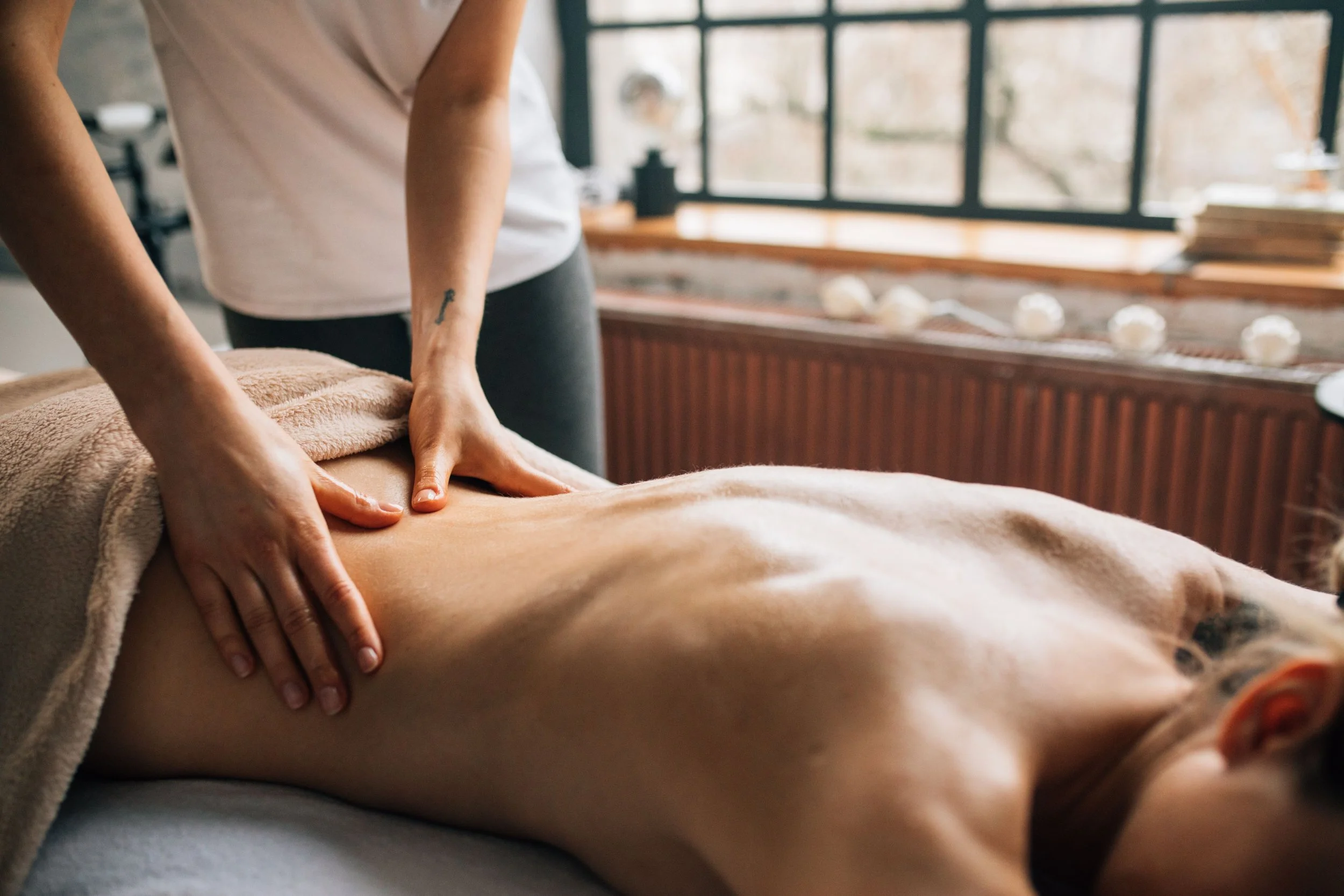
A licensed massage therapist can work carefully on those muscles. Many people find it eases the tension, helps them sleep, and makes moving feel less guarded. Research on massage for low back and neck pain shows it can bring real relief, especially as part of a broader plan with your doctor or PT.
What a session looks like
Expect a careful conversation first: where the disc issue is, what your doctor or PT has told you, which movements make it worse, and whether you have symptoms down an arm or leg.
Positioning matters a lot. Some people can't lie face down comfortably, so side-lying with pillows is common. Pressure stays moderate around the spine itself, and your massage therapist should check in often. If anything triggers shooting pain, tingling, or numbness, say so right away, and the work will change.
When to see a doctor first
Get medical care before booking, and urgently for the first two, if you have:
Numbness in the groin or inner thighs
New trouble controlling your bladder or bowels
Weakness in an arm, hand, leg, or foot that's getting worse
Symptoms that started after a fall, accident, or injury
Pain along with fever or unexplained weight loss
How long does a herniated disc take to get better?
For most people, the outlook is better than the diagnosis sounds. The American Academy of Orthopaedic Surgeons says a herniated disc in the lower back usually improves slowly over days to weeks, and most people are free of symptoms by three to four months.
Massage can make the weeks in between more comfortable, alongside the plan your doctor or PT gives you.
Living with it in New York
A disc problem in this city is a logistics problem as much as a physical one. A few things people find useful:
Swap the overloaded tote for a backpack worn on both shoulders.
Break up long sitting. Even standing for one call an hour helps.
Take the elevator or escalator when your back is flaring, without guilt.
Keep doing the exercises your PT gave you. That work matters more than any single session of anything.
Where to book
Desk-heavy schedules bring a lot of disc questions to our Manhattan studios in Union Square and Columbus Circle, but every PRESS studio, including Williamsburg and Greenpoint in Brooklyn and Long Island City, Queens, has licensed massage therapists who work with this regularly. Leave a note about your disc when you book. For a focused session, Back, Neck & Shoulders is a good place to start.
FAQ
Is massage safe with a herniated disc?
Often, yes, once a doctor has looked at it and nothing points to nerve damage that needs urgent care. Tell your massage therapist about it so they can adjust positioning and pressure.
Can massage fix a bulging disc?
No. It can ease the muscle tension around the area. Many discs improve over time with conservative care your doctor or PT guides.
Should I avoid deep pressure?
Near the spine, usually yes. Firmer work on the hips and shoulders can still feel good. Here's how we think about pressure.
Can massage make a herniated disc worse?
Heavy pressure near the spine or awkward positioning could aggravate symptoms, which is why the work stays moderate there and you lead on comfort. Tell your massage therapist right away if symptoms travel down an arm or leg.
Is it okay to lie face down with a herniated disc?
For some people, yes. Others are more comfortable on their side with pillows. Your massage therapist will adjust the setup.
Can I get a massage for a herniated disc in my neck?
Often, yes, once a doctor has checked it. The focus is usually the neck, shoulders, and upper back, with gentle pressure near the spine.
How many massages will I need?
There's no set number. Some people come weekly for a few weeks while symptoms settle, then less often.
Read also:
Rachel Beider is the Founder and CEO of PRESS Modern Massage, an independently owned group of massage studios in New York City specializing in personalized, anatomy-informed therapeutic bodywork. A New York State Licensed Massage Therapist and the author of Press Here! Massage for Beginners, Beider founded the company in 2008 with a focus on combining clinical expertise with a modern, client-centered experience. Her work and insights have been featured by publications including The Wall Street Journal, Forbes, Entrepreneur, and Refinery29.