
Massage for Stress and Sleep in NYC: Does It Help?
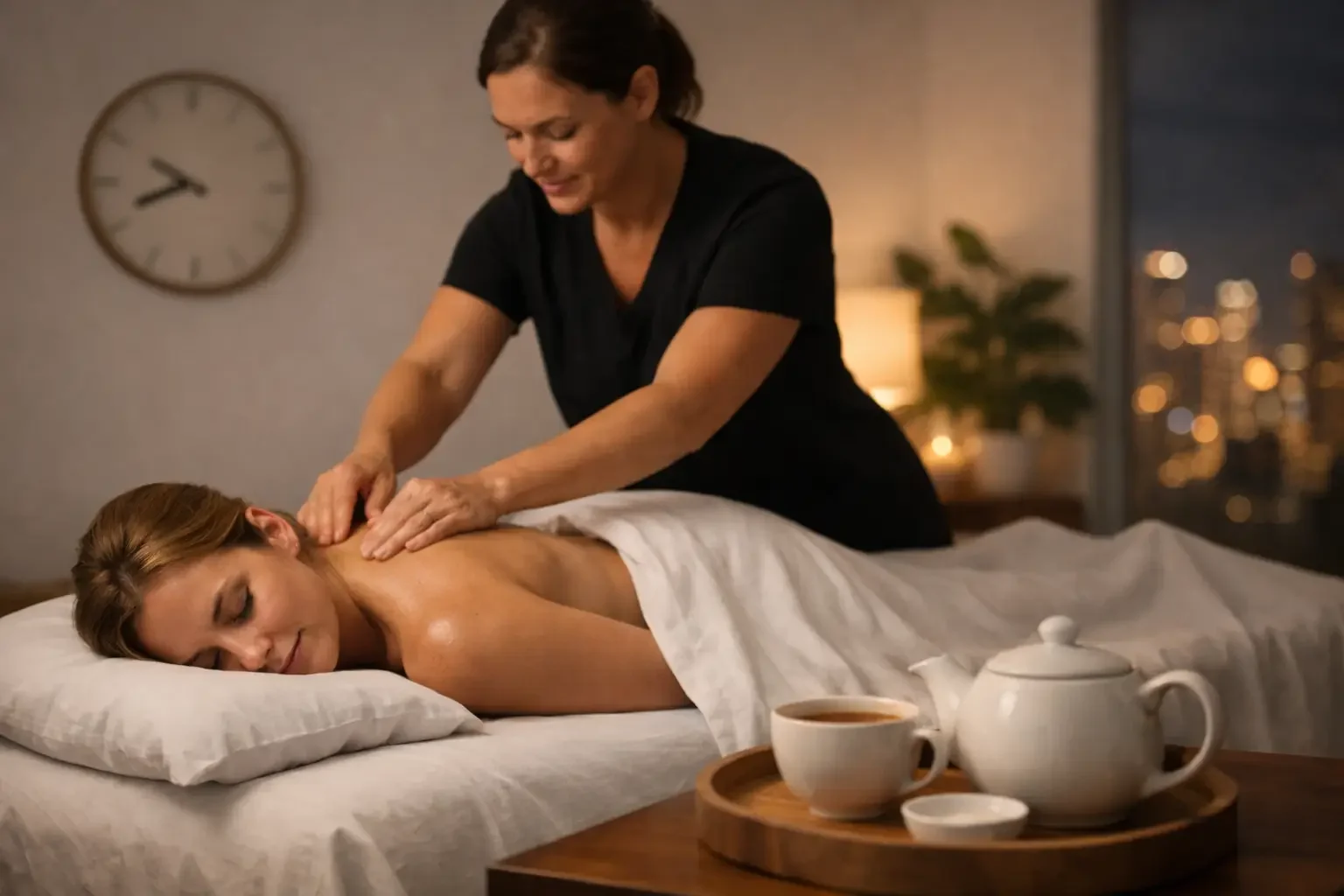
New York has a complicated relationship with rest. This is a city where "How are you?" is routinely answered with "Busy," where sleep is treated as a negotiable line item, and where an alarming number of people do their best work between 10 p.m. and the moment the laptop finally dies. Then everyone wonders why their shoulders live near their ears and their brain will not power down at bedtime.
If you have found yourself searching for massage for stress and sleep in NYC, the honest question is whether an hour on a table can genuinely help with either. The honest answer: massage is not a sedative, and it will not delete your calendar. But for many people, it can lower the physical volume of stress enough that rest becomes easier to reach.
The Stress Piece: What Massage Can Actually Change
Stress is not only a mental state. It is a body strategy. Under sustained pressure, deadlines, financial math, caregiving, the ambient intensity of this city, many people carry low-grade muscular bracing all day: a set jaw, lifted shoulders, shallow breathing, a back that never quite unclenches. Over weeks, that bracing becomes the default, and the body forgets it is doing it.
Massage interrupts the pattern. Sustained, comfortable pressure gives the nervous system a credible signal that it can downshift, and research suggests massage may help reduce stress-related tension and support relaxation, though effects vary from person to person. What most people notice is simpler than the research language: breathing gets deeper, the jaw lets go, and the mental static quiets a notch.
That is not a cure for stress. It is a reset that makes the next few days more manageable, which is often what a stretched-thin week actually needs.
The Sleep Piece: Why Tension and Rest Are Connected
Poor sleep in New York has many authors: late screens, noise, stress spirals, an espresso decision you made at 4 p.m. Massage cannot fix all of them. What it can address is the physical layer, because a tense body is genuinely harder to sleep in.
If your shoulders, neck, and back are braced, lying down does not automatically release them. Many people carry their workday into bed as muscle tension, then toss, reposition, and wake with the same stiffness they brought under the covers. By reducing that muscular guarding and nudging the nervous system toward its rest state, massage can make the transition into sleep less of a standoff.
People commonly report sleeping deeply the night after a session. That effect is real but temporary, which is why massage works better as a recurring part of a sleep-supportive routine than as a one-time interventiona, a point worth being honest about. The rest of the routine still matters: consistent wake times, dimmer evenings, less doomscrolling, and a bedroom that is not also your office, to whatever degree your apartment allows.
What a Stress-and-Sleep Session Looks Like
Tell your massage therapist the actual goal. "I want to relax" is fine; "I cannot fall asleep because my upper back will not let go, and my jaw aches by Friday" is far more useful. The session can then be built for downshifting: slower pacing, broad grounding strokes, focused work where you brace hardest, typically the neck, shoulders, upper back, and jaw area, and pressure that stays firmly on the comfortable side of intense.
This is one place where deeper is often not better. Aggressive work can leave a stressed nervous system more activated, not less. A full body session at a moderate, responsive pressure is usually the right instrument for stress and sleep, and you can always ask for quiet: you are not required to make conversation for the hour to count.
Evening appointments have an obvious logic for sleep support: you leave downshifted and head toward bed instead of back into your inbox. But a lunchtime session works too, the calmer baseline tends to carry through the day. Book the slot you will actually keep.
Making It a Routine Instead of a Rescue
The New York pattern is to ignore stress until it becomes a crisis, then throw one dramatic intervention at it. A better model, for bodies and for sleep, is boring consistency. A monthly or otherwise regular session keeps the tension baseline lower, gives your massage therapist a read on your patterns, and turns the calm into something your week can count on rather than a rare event. (That cadence is what the PRESS membership exists for.)
Pair it with the unglamorous fundamentals and the effect compounds: movement during the day, daylight in the morning, a wind-down that does not involve your work laptop, and honesty about caffeine. Massage does its best work as part of that system, the piece that addresses the physical residue the other habits cannot reach.
When Sleep Trouble Needs More Than Massage
Persistent insomnia, loud snoring with gasping or breathing pauses, restless legs, or sleep problems paired with low mood or anxiety that will not lift deserve a conversation with a medical or mental-health professional. Massage can sit comfortably alongside that care, but it should not stand in for it. If your sleep has been broken for months, get it looked at, and let massage be the supporting act it does well.
At PRESS
PRESS offers anatomy-based massage from licensed massage therapists in Williamsburg, Brooklyn; Greenpoint, Brooklyn; Union Square, Manhattan; Columbus Circle, Manhattan; and Long Island City, Queens. Book here, tell us your week has been a lot, and take the quiet hour. Sleep tends to follow bodies that have been given permission to stop bracing.
Read also:
