
Massage for Grief: When Loss Lives in the Body
Grief has terrible timing.
It follows you onto the subway. It appears halfway through a meeting. It waits until you're standing in a Key Food trying to remember what you came in for. In New York, there is also the strange experience of having something enormous happen to you while approximately eight million people continue walking at full speed.
The city does not stop because someone you love has died.
Your body, however, may have other ideas.
After a loss, people often notice changes that feel surprisingly physical: shoulders creeping toward the ears, a clenched jaw, headaches, exhaustion, an unsettled stomach, shallow breathing, trouble sleeping, or a heavy feeling across the chest. Grief is emotional, but that doesn't mean it exists only in your thoughts.
This is one reason massage can feel useful during bereavement. Not because massage can remove grief, it can't, but because for an hour, you can stop performing competence and pay attention to the body carrying it.
Grief isn't only something you think about
Bessel van der Kolk's The Body Keeps the Score helped popularize the idea that difficult experiences can have a bodily dimension. The book is specifically about trauma, and not every bereavement should automatically be labeled traumatic. Still, its larger emphasis on body awareness is useful: what happens psychologically can affect how we breathe, brace, sleep and move.
For grief specifically, neuroscientist Mary-Frances O'Connor's The Grieving Brain offers another helpful frame. Her work looks at bereavement as a process in which the brain has to adapt to a profound contradiction: someone who was deeply encoded into our everyday expectations is suddenly no longer there.
That adjustment takes energy.
Sometimes quite a lot of it.
The American Psychological Association notes that grief can be intensely disruptive and that social support, healthy habits and time are important parts of adapting after a loss. There is no universally correct schedule, despite the number of people who will eventually ask whether you're "doing better."
What massage for grief can actually do
Massage should not be sold as grief treatment. Research into massage and emotional symptoms is mixed, and the evidence is nowhere near strong enough to claim that bodywork resolves psychological distress. What massage can offer is more modest, and, at certain moments, more useful.
It can create a quiet, structured period in which you do not have to answer an email, organize a memorial, call an insurance company, respond to condolences or explain how you're feeling.
Research reviewed by the National Center for Complementary and Integrative Health suggests massage may help with relaxation, muscular tension and anxiety in some populations, although findings vary and the evidence has limitations.
For someone grieving in New York, the appeal may be even simpler: sixty or ninety minutes during which nobody needs anything from you.
That is not nothing.
A gentler kind of massage makes sense here
Grief is generally not the moment for someone to attack your trapezius because you selected "firm pressure" on an intake form six months ago.
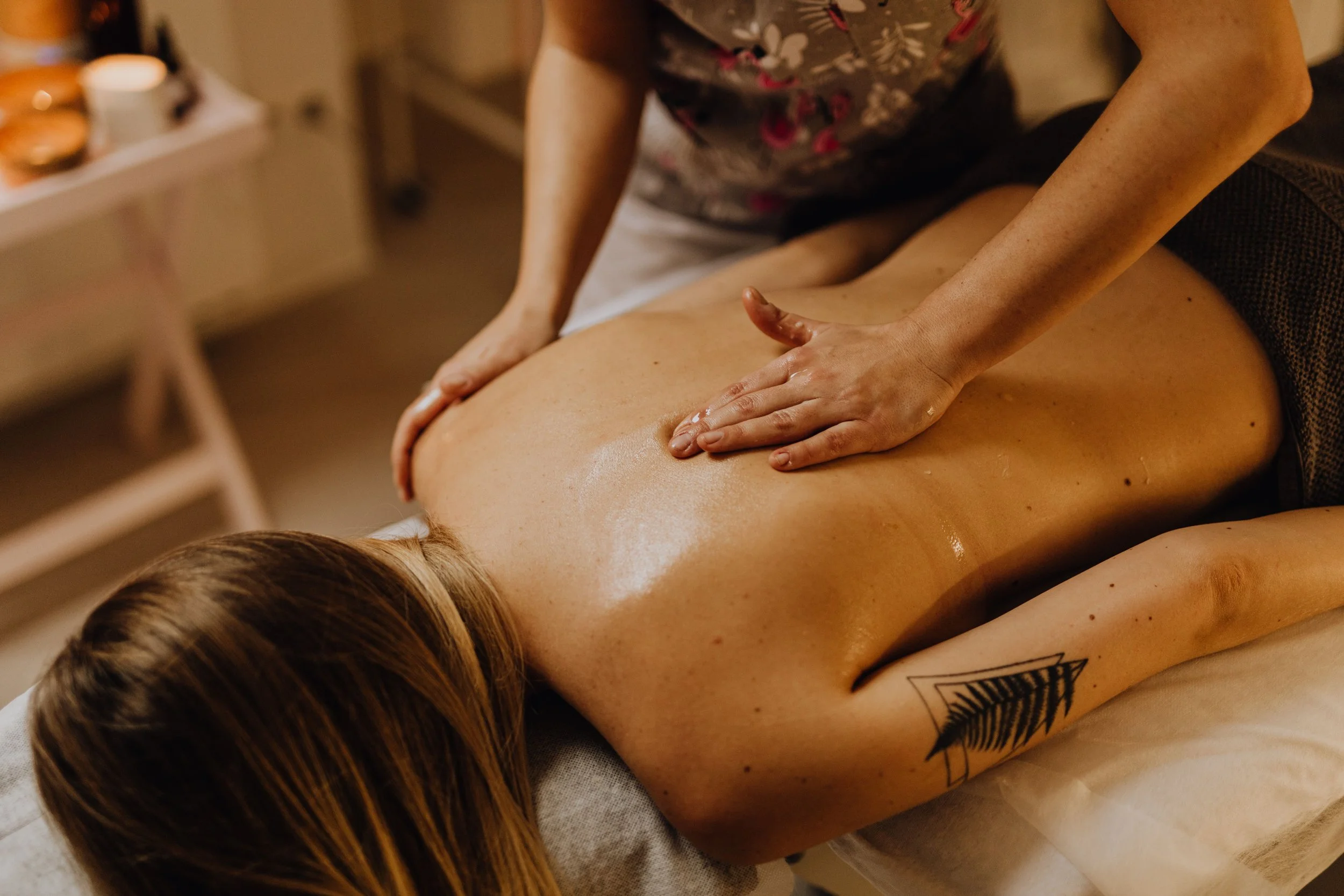
A grief-sensitive massage can be slower and less goal-oriented. Think long, grounding strokes along the back and arms; gentle work around the shoulders and neck; unhurried attention to the hands and feet; and, where appropriate and clearly consented to, soft work around the upper chest, pectoral area and shoulders. (Our full body session can be exactly this when you ask for it to be.)
You could call these heart-opening strokes, although they don't need a mystical explanation to be worthwhile. When we're distressed, many of us physically close in: shoulders round, arms draw toward the torso and breathing gets smaller. Gentle work through the front of the shoulders, upper chest and arms can invite a little more space without forcing anything.
The important word is gentle.
There is no prize for enduring aggressive pressure while grieving.
Start by noticing where grief is sitting today
Before a massage begins (and if you've never had one, here's what to expect), try asking yourself a more useful question than "Where are you tight?"
Where do you feel the loss today?
Maybe it's the familiar knot between your shoulder blades. Maybe your jaw has been clenched since the funeral. Maybe your stomach feels hard. Maybe your chest feels heavy. Maybe you don't notice much of anything, which is also information.
This kind of body scan doesn't require interpreting every sensation. A tight hip is not secretly your relationship with your father.
Just notice.
Jaw. Throat. Chest. Belly. Hands. Shoulders. Back.
Where are you holding? Where are you numb? Where does breathing feel easy, and where does it stop?
Simply registering those sensations can give a massage therapist a better idea of how to work with you that day.
Deep breathing, without turning it into another assignment
"Take a deep breath" is annoying advice when delivered by someone who would like you to stop being upset.
During massage, it can be different.
Try inhaling slowly through the nose and allowing the breath to expand the ribs rather than lifting only the upper chest. Then make the exhale slightly longer and easier.
You don't have to breathe perfectly. You don't need to count to seven or visualize a white light entering your spleen.
The point is simply to notice when you're holding your breath.
New Yorkers are unusually good at this. We hold it while squeezing onto a packed 6 train, reading an alarming email, carrying groceries five avenues farther than anticipated and pretending we're not late.
Grief can intensify that bracing.
Massage gives you a chance to put some of it down.
Taking care of yourself after a loss in New York
The standard grief advice tends to sound suspiciously as though the bereaved person has moved to a cottage with no job.
"Rest."
"Spend time in nature."
"Lean on community."
Excellent. You have a 9:30 meeting in Flatiron.
The useful version is smaller.
Eat something before 4 p.m., even when cooking feels absurd. Get outside in daylight. Walk around the Reservoir, Prospect Park, Fort Greene Park or the Hudson River rather than spending another hour scrolling in bed. Let a friend come sit in your apartment without feeling obligated to entertain them. Ask someone else to deal with one piece of death administration that you cannot face today.
Protect sleep where you can. Move your body without turning exercise into emotional punishment. Consider therapy or a grief group if you want more structured support.
And make rituals that fit your actual life.
That might mean visiting the same bench in Riverside Park every Sunday. Buying their favorite pastry. Walking across the Brooklyn Bridge at sunrise on their birthday. Cooking something they used to make. Taking the ferry simply because being near water makes the city feel briefly larger than your grief.
Grieving doesn't require withdrawing from New York. Sometimes the city can hold part of it.
Massage can be one part of the support system
A massage after loss does not have to produce a breakthrough.
You do not have to cry on the table for it to "work." You also don't have to prevent yourself from crying if it happens.
The session can simply be a place to notice your body again: the weight of your legs, the movement of your ribs, your back against the table, the fact that your jaw has finally unclenched.
There is something useful about being cared for without having to make conversation, particularly after weeks of answering one impossible question:
"How are you?"
Massage cannot answer that.
But it can give your body an hour in which it doesn't have to.
A note on care: Massage is complementary support, not a substitute for medical or mental-health care. If grief feels unmanageable, you're unable to function for an extended period, or you're concerned about your physical or emotional safety, reaching out to a qualified healthcare or mental-health professional is important.
At PRESS
If an hour like that would help, our licensed massage therapists are at our studios in Williamsburg, Greenpoint, Union Square, Columbus Circle, and Long Island City, Queens. Book here, and if you'd like the session to be gentle, unhurried, and quiet, just say so. That's enough of an explanation.
Read also: