
When to Get Recovery Massage for Runners in NYC
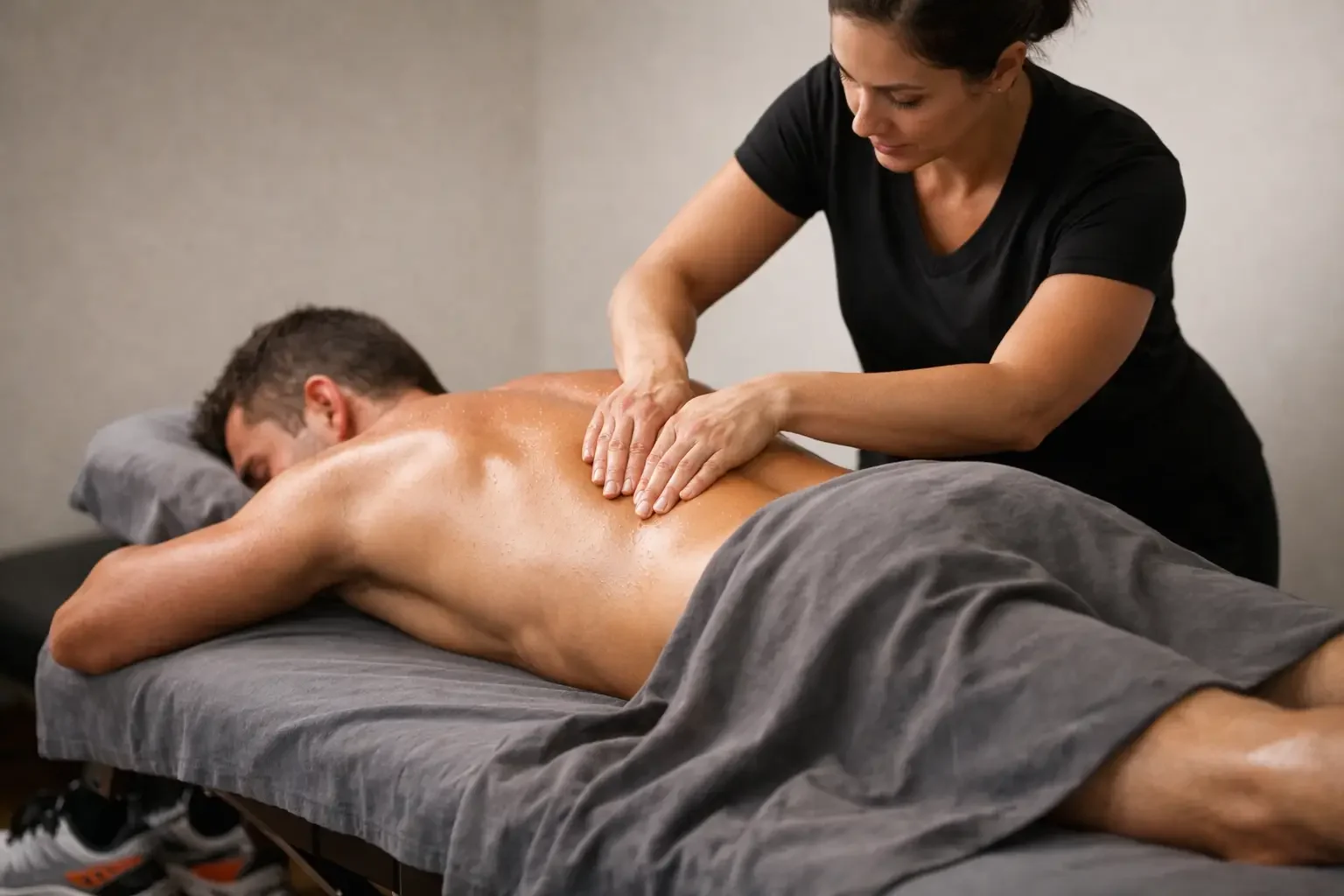
Running in New York is a contact sport against the city itself. Concrete instead of trails, bridge inclines that double as hill repeats, dodging pedestrians on the park loop, and a training schedule squeezed between work and everything else. Your legs absorb all of it. The question is not whether recovery matters, every runner learns that eventually, usually mid-staircase. The question is when a recovery massage actually helps, and what kind to book.
The honest answer depends on where you are in your training week, not on how tough you are or how much soreness you can ignore.
What Recovery Massage Does for Runners (and What It Doesn't)
Start with the honest inventory. Massage for runners reliably helps with the perception of soreness after hard efforts, short-term improvements in how freely the legs move, easing the guarded, heavy feeling in overworked calves, quads, and hips, and the kind of nervous-system downshift that makes sleep, where the actual repair happens, come easier.
What it does not do: flush lactic acid (your body clears that on its own within about an hour of finishing), directly make you faster, or substitute for sleep, food, easy days, and sensible mileage progression. Any promise bigger than that is marketing. What massage earns its place doing is keeping you comfortable and moving well enough to show up for the next run, which, over a training cycle, is where speed actually comes from.
There is one more benefit runners underrate: a massage therapist who works on you regularly notices things. The right calf that is always tighter. The hip that only complains after track work. The early signs of an overuse pattern while it is still a maintenance problem instead of an injury. That pattern recognition is worth as much as the hands-on hour.
When to Book It: The Timing Rules
After a long run or hard workout: wait 24 to 48 hours. Right after a big effort, your muscles are inflamed and legitimately damaged in the microscopic way training requires. They want food, fluids, and sleep before they want elbows. A day or two later, a recovery-focused session helps with the soreness and stiffness without piling stress on tissue that is mid-repair. (Post-race is its own protocol, same logic, bigger numbers.)
In a regular training block: every two to four weeks. This is the maintenance rhythm for most consistent runners, frequent enough that tightness never gets a lease, spaced enough that deeper work has time to settle before the next quality session. Schedule it on an easy or rest day, not the night before intervals.
Before a race: light, and not last-minute. Deep, aggressive work in the final days before a race can leave your legs tender and flat. If you want bodywork race week, keep it gentle and at least a few days out, and save the focused deep tissue work for after, or for weeks when the calendar has room to recover from recovery.
When something hurts in a pointed way: pause and get it looked at. Sharp pain, swelling, pain that changes your stride, or anything that worsens as you run is a medical question first. A massage therapist supports rehab; they do not diagnose stress fractures. The runners who lose whole seasons are usually the ones who massaged and foam-rolled a real injury for six weeks first.
What a Runner's Session Actually Looks Like
Tell your massage therapist you run, and be specific: weekly mileage, what is coming up, where the tightness lives, and what feels different lately. "My calves are always tight" is a start. "My left calf started grabbing on bridge climbs two weeks ago when I added speed work" is a treatment plan.
Expect the work to concentrate where running concentrates: calves, quads, hamstrings, glutes, hip flexors, and the feet, which absorb several thousand collisions per run and are criminally under-thanked for it. Expect it to be more active than a melt-into-the-table hour when that serves the goal: movement through range, focused pressure where tissue is guarding, sometimes stretching folded into the work. And expect pressure to be a conversation, not a test. Legs that are already trashed from training do not need to be conquered; mild next-day tenderness can be normal, being wrecked is not.
Where This Fits in a New York Running Life
The practical advantage of recovering in the city you train in: the studio can sit on your actual route. Long runs around Central Park pair with our Columbus Circle studio at the southwest corner of the loop. Brooklyn runners circling Prospect Park or doing bridge repeats have Williamsburg and Greenpoint. The waterfront-path crowd in Queens has Long Island City. Recovery you can reach without a second commute is recovery that actually happens, the same rule as every other part of training.
And if you run year-round, recover year-round: a membership turns the every-few-weeks rhythm into a default instead of a decision, which is exactly how the rest of your training works. You do not re-decide whether to do the long run each week. Recovery deserves the same standing appointment.
The Simple Version
Book recovery massage 24 to 48 hours after your hardest efforts or on easy days in a regular rhythm, keep race-week work light and early, tell your massage therapist what you are training for, and let something sharp or worsening see a clinician before it sees a table. Your training plan already schedules the stress. This is how you schedule the other half.
At PRESS
PRESS offers anatomy-based sports and recovery massage from licensed massage therapists in Williamsburg, Brooklyn; Greenpoint, Brooklyn; Union Square, Manhattan; Columbus Circle, Manhattan; and Long Island City, Queens. Book your recovery day here, and tell us what you are training for.
Read also:
Written by Rachel Beider, LMT, founder of PRESS Modern Massage. Rachel is a New York State–licensed massage therapist and AMTA member with nearly two decades of experience in massage therapy and wellness.
